Best Impact-Resistant Doors for Temecula Wildfire Zones
Tested recommendations for fire-rated, ember-resistant entry doors in Temecula's WUI zones, with specific ratings, brands, and clearances that meet CBC Chapter 7A code.
 Written by Drew Guthrie, Owner & Lead Estimator · Updated April 22, 2026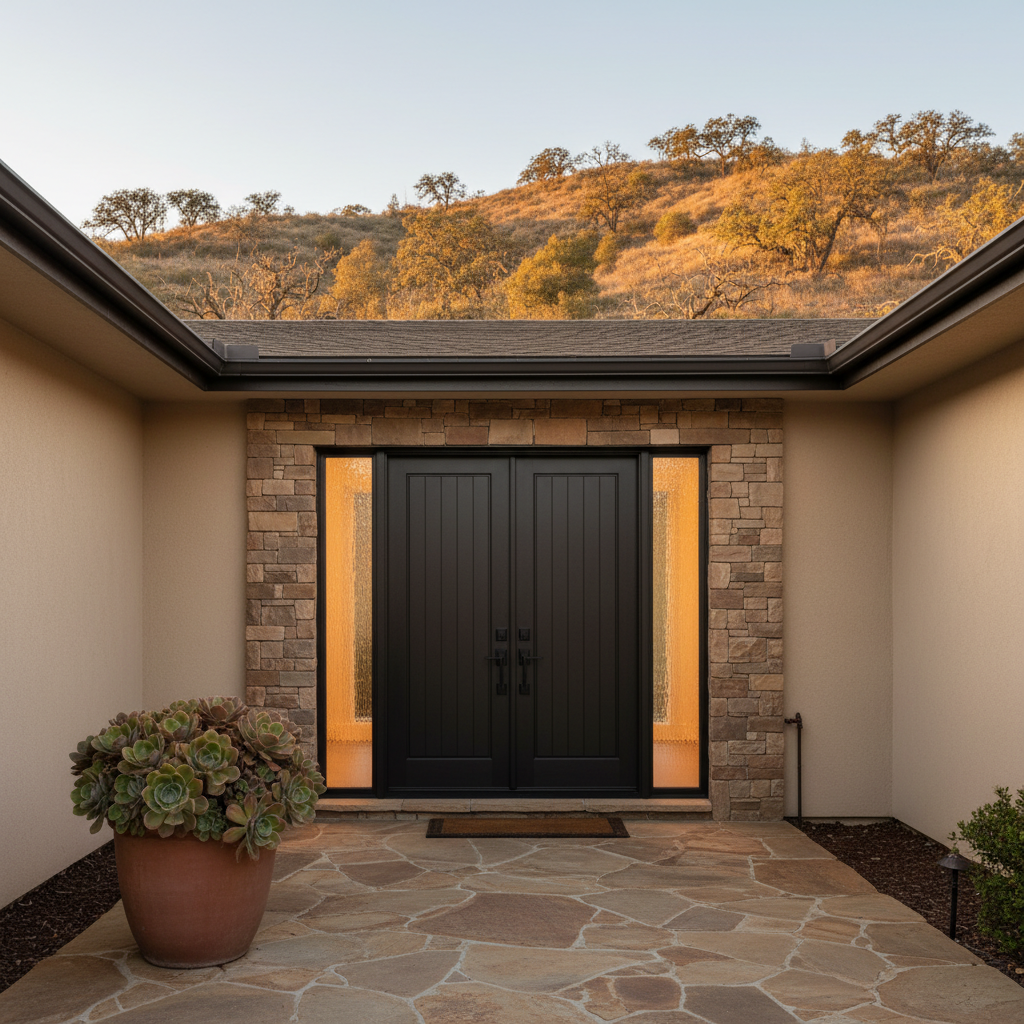
TL;DR
- Doors in Temecula's WUI zones (92590, 92591, 92592) must meet CBC Chapter 7A standards with a minimum 20-minute fire rating and ember-resistant seals tested per SFM 12-7A-4.
- Fiberglass doors from Therma-Tru and Plastpro outperform steel in our climate because they don't warp under 105°F summer heat and maintain their fire rating through Santa Ana wind cycles.
- The gap between your door and frame must not exceed 1/8 inch per code, and standard weatherstripping fails ember intrusion tests while specialized seals add $180–$240 to your installation.
- A code-compliant fire-rated entry door costs $2,800–$4,200 installed in Temecula, with dual-pane tempered glass sidelites adding another $800–$1,100 if you want natural light without sacrificing protection.
- Doors in Temecula's WUI zones (92590, 92591, 92592) must meet CBC Chapter 7A standards with a minimum 20-minute fire rating and ember-resistant seals tested per SFM 12-7A-4.
- Fiberglass doors from Therma-Tru and Plastpro outperform steel in our climate because they don't warp under 105°F summer heat and maintain their fire rating through Santa Ana wind cycles.
- The gap between your door and frame must not exceed 1/8 inch per code, and standard weatherstripping fails ember intrusion tests while specialized seals add $180–$240 to your installation.
- A code-compliant fire-rated entry door costs $2,800–$4,200 installed in Temecula, with dual-pane tempered glass sidelites adding another $800–$1,100 if you want natural light without sacrificing protection.
Every August I get the same call. Homeowner in Redhawk or Harveston just got their insurance renewal, and the carrier wants proof of WUI compliance or they're dropping coverage. The door is always the sticking point. Most homes built before 2010 have builder-grade steel doors with zero fire rating and gaps you can see daylight through. When embers hit those gaps during Santa Ana winds, they slip inside and ignite whatever's in the entryway.
I've been installing replacement doors in Temecula since 2002, and the wildfire code has tightened three times in that span. What passed inspection in 2008 won't pass today. Here's what actually works in our WUI zones, what the code requires, and what you'll pay for real protection.
What does California Building Code Chapter 7A actually require for doors?
CBC Chapter 7A is the Wildland-Urban Interface code that governs construction in fire-prone areas. If you're in ZIP codes 92590, 92591, or 92592 and within one mile of wildland vegetation, your entry doors need:
- A minimum 20-minute fire rating tested to SFM Standard 12-7A-1
- Ember-resistant weatherstripping and seals tested to SFM 12-7A-4
- Maximum 1/8-inch clearance between door and frame on all edges
- Noncombustible or ignition-resistant threshold
- If the door includes glass, it must be tempered dual-pane rated for radiant heat
The entire assembly—slab, jamb, hinges, seals—must carry a California State Fire Marshal listing number. You can't mix and match a fire-rated slab with a non-rated frame. The certification is void if you drill new holes, cut the door down, or swap the weatherstripping for generic foam.
Riverside County building inspectors check three things during final: the SFM label on the hinge edge of the door, the matching label on the jamb, and the clearance gap with a feeler gauge. I've seen inspectors fail installations where the door was certified but the installer left 3/16-inch gaps because they didn't want the door to bind.
Why do fiberglass doors outperform steel in Temecula's climate?
Steel doors are cheaper up front—$1,800–$2,400 installed versus $2,800–$3,600 for fiberglass. But steel doesn't hold up in Climate Zone 10.
When the sun hits a west-facing steel door at 3 p.m. in July, surface temperature hits 140–160°F. The foam core expands and the steel skin warps. I've measured doors that are 1/4 inch out of square after two summers. The warping changes your clearance gaps—what started at 1/8 inch is now 3/16 on the latch side and nearly zero at the top. That creates binding and ember pathways.
Steel also rusts. Temecula's irrigation water is hard—300–400 ppm total dissolved solids. Overspray hits the door bottom, and within three years you'll see rust bloom along the bottom rail. Once the factory finish breaks down, the steel corrodes fast. I replaced 11 steel doors in Meadowview last year, all between 8 and 12 years old, all with rust-through at the bottom.
Fiberglass doesn't rust, doesn't warp, and holds its fire rating through temperature swings. Therma-Tru's Classic-Craft and Plastpro's Model DRG series both carry 20-minute fire ratings and SFM ember-resistance certification. The fiberglass skin is molded with wood-grain texture that takes paint or stain. We've installed Therma-Tru doors in Paloma del Sol and Wine Country that are 15+ years old and still square, still seal tight, still look factory-new.
The only downside is denting. A hard impact—furniture during a move, a kicked soccer ball—can crack the fiberglass skin. Steel dents but doesn't crack. In 22 years I've seen maybe a dozen cracked fiberglass doors versus hundreds of warped and rusted steel units.
What's the real difference between standard and ember-resistant weatherstripping?
Standard foam or vinyl bulb weatherstripping fails the ember intrusion test within 90 seconds. SFM 12-7A-4 testing exposes the seal to direct flame and wind-driven embers. Foam melts, vinyl shrinks, and embers push through.
Ember-resistant seals use intumescent material that expands when heated, closing gaps even tighter under fire exposure. The most common systems we install:
- Pemko's S88 intumescent seal with silicone bulb—rated for 20-minute assemblies, costs $85–$110 per door
- National Guard Products' E-Stripping—dual-layer design with graphite intumescent core, $95–$125 per door
- Zero International's Zero 730 series—compression seal with embedded intumescent, $105–$140 per door
We charge $180–$240 to install the full perimeter seal system—top, sides, and threshold. That includes removing the old weatherstripping, routing the jamb if necessary to fit the new profile, and adjusting door clearance to maintain 1/8 inch while still compressing the seal.
These seals also improve energy performance. Homes we upgrade in Harveston and Crowne Hill see 12–18 percent reduction in cooling load during summer because the seal stops air leakage. That's $18–$35 per month in savings on a 2,400-square-foot home with the AC running from May through October.
How much does a code-compliant fire-rated door cost installed?
For a standard 36-inch single entry door with no sidelites or glass, you're looking at:
- Therma-Tru Classic-Craft fiberglass, 20-minute rated: $2,800–$3,400 installed
- Plastpro DRG fiberglass, 20-minute rated: $2,650–$3,200 installed
- Masonite VistaGrande steel, 20-minute rated: $2,200–$2,700 installed (but expect warping and rust within 10 years)
That price includes the pre-hung unit, ember-resistant weatherstripping, labor, hauling away the old door, and patching stucco or trim as needed. It does not include painting—we install factory-primed doors and the homeowner arranges finish painting, which typically costs another $280–$420 if you hire it out.
Add sidelites with tempered dual-pane glass and you're at $3,600–$4,800 total. Decorative glass (beveled, leaded, frosted patterns) that's also fire-rated costs more—figure $4,200–$5,400 for the full assembly.
Double doors (5 feet or 6 feet wide) start at $4,800 and run up to $7,200 for fiberglass with sidelites and transom glass. I did a Wine Country estate last year with an 8-foot Therma-Tru double-door system, full sidelites, arch-top transom, all fire-rated—that was $9,800 installed.
Permit fees in Temecula run $220–$285 for a door replacement, and we handle that as part of the job.
Can I install decorative glass or sidelites and still meet fire code?
Yes, if the glass is part of the fire-rated assembly. The entire door system—slab, frame, glass, muntins—must be tested together and carry the SFM listing.
Single-pane glass fails radiant heat testing. You need dual-pane tempered glass with a minimum air gap (usually 1/2 inch to 3/4 inch) and Low-E coating. Therma-Tru and Plastpro both offer fire-rated door lites and sidelites with their fiberglass systems. The glass is factory-installed and the whole assembly ships as one pre-hung unit.
Decorative patterns—beveled borders, privacy obscure, frosted designs—are available in fire-rated configurations, but not every pattern qualifies. The manufacturer has to test each specific design. I've had homeowners pick a beautiful leaded-glass pattern from a showroom only to find out it's not available in a 20-minute rated version.
We handle a lot of window and door projects in Wine Country estates where aesthetics matter as much as code compliance. The key is choosing your glass early in the process so we can confirm the rating and lead time. Fire-rated decorative glass often has 8–12 week lead times versus 3–5 weeks for standard clear lites.
Transom windows above the door also need to be fire-rated if they're part of the same opening. We've done several installations where the homeowner wanted an arch-top transom for curb appeal—that's fine, but it adds $1,100–$1,600 to the job because it's custom-built to match the arch and must include tempered dual-pane glass that's tested with the door assembly.
Which door brands actually hold up in Temecula's WUI zones?
I install four brands regularly, and I can tell you how each performs after years in our climate.
Therma-Tru Classic-Craft fiberglass: The best overall for fire rating, durability, and finish quality. Available in smooth or wood-grain texture. The factory finish system is polyurethane over fiberglass and it resists UV better than field-applied paint. We install dozens of these in Redhawk, Paloma del Sol, and Harveston every year. Twenty-year track record in Temecula with zero warping, zero delamination. Costs $2,800–$3,600 for a single door, more with glass. Lead time is 4–6 weeks.
Plastpro DRG and Model 30 fiberglass: Slightly lower cost than Therma-Tru—$2,650–$3,200 installed—and just as durable. The wood-grain molding is a bit less detailed, so if you're staining the door instead of painting, Therma-Tru looks more realistic. But for painted applications Plastpro is a great value. Same 20-minute fire rating, same SFM certification. We use these a lot in Murrieta and Menifee where budget is tighter but code compliance is still required.
Masonite VistaGrande steel: The lowest up-front cost at $2,200–$2,700 installed, and it meets the 20-minute fire rating. But I warn every client: expect rust and warping within 10 years. If you're planning to sell in 5–7 years and need to meet code now, fine. If you want a door that lasts 20+ years, spend the extra $600 and go fiberglass.
Andersen A-Series wood-clad fiberglass: Premium option for high-end homes. Fiberglass core with aluminum cladding on the exterior, wood veneer on the interior. Meets fire rating, looks like a true wood door, costs $4,800–$6,200 installed. We install these in custom Wine Country builds where the architectural style demands wood aesthetics but the homeowner understands the maintenance trade-off. The aluminum cladding protects the wood from UV and moisture, but the wood interior still needs refinishing every 6–8 years.
I don't install solid wood doors in WUI zones anymore. Even with fire-retardant treatment, wood checks and cracks along the panels, creating gaps that fail ember intrusion testing. And the maintenance burden—sanding, staining, sealing every 3–4 years—isn't worth it when fiberglass gives you the same look with zero upkeep.
What about the threshold and hardware—do those need special ratings too?
Yes. The threshold must be noncombustible (aluminum, steel) or ignition-resistant composite. Standard oak or composite-wood thresholds burn and fail the test.
We install Pemko aluminum thresholds with integral weatherseal on every fire-rated door. The threshold sits on a bed of fire-rated sealant and screws into the concrete slab or wood subfloor. Proper installation requires shimming and leveling—the threshold must make continuous contact with the door bottom seal across the full width. A 1/16-inch gap at one end will fail inspection.
Hinges don't need a separate fire rating, but they must be steel (not brass or aluminum) and must be sized correctly for the door weight. A 36-inch fiberglass door weighs 90–110 pounds. We use three heavy-duty steel ball-bearing hinges rated for 200 pounds. Undersized hinges let the door sag, which changes your clearance gaps and voids the certification.
Locksets and deadbolts also matter. Drilling oversized holes for decorative handlesets can compromise the fire rating if the hole penetrates the intumescent core. We stick with standard 2-1/8-inch bore holes and use Schlage or Kwikset deadbolts rated for exterior use. The latch and strike must maintain the 1/8-inch clearance spec—if the latch is adjusted too far out, the door won't close tightly enough to compress the ember seals.
How do I know if my current door meets WUI code or needs replacement?
Check the hinge edge of the door for a metal label. It'll say "California State Fire Marshal," list a test standard (SFM 12-7A-1 or ASTM E152), and show a time rating (20-minute, 60-minute, 90-minute). If there's no label, the door isn't rated.
Next, check the clearance gaps. Close the door and slide a business card (about 1/16 inch thick) into the gap along the top, sides, and bottom. If the card slides in with zero resistance, your gaps are too wide. You should feel light friction. If you can fit two business cards stacked, you're definitely over 1/8 inch and out of compliance.
Look at the weatherstripping. Foam or vinyl bulb seals are not ember-resistant. Intumescent seals are usually gray or graphite-colored and have a denser, firmer feel. If you're not sure, call us at (951) 757-4340 and we'll come out for a free inspection. We bring a feeler gauge and can tell you in five minutes whether your door meets code.
If your door was installed before 2008 and you're anywhere near open space or hillsides in Temecula, Murrieta, or Fallbrook, it probably doesn't meet current standards. The code has been updated three times since then. Even doors that were compliant in 2010 may not pass today's ember intrusion testing.
Insurance companies are getting stricter. We've done four projects this year where the carrier ordered a WUI inspection, found non-compliant doors, and gave the homeowner 90 days to upgrade or lose coverage. Don't wait for that letter. If you're refinancing, selling, or renewing a policy, get ahead of it.
People Also Ask
What fire rating do doors need in Temecula wildfire zones?
Doors in Temecula's Wildland-Urban Interface zones require a minimum 20-minute fire rating per CBC Chapter 7A, tested to SFM 12-7A-1 standards. Most of Redhawk, Harveston, and Wine Country fall into this zone. The door must resist flame penetration and maintain structural integrity while exposed to radiant heat. We verify compliance with the manufacturer's listing label, which must remain visible after installation.
Do impact-resistant doors also protect against wildfires?
Not automatically. Impact resistance refers to hurricane debris or forced-entry testing, which is different from wildfire protection. A door can pass Miami-Dade impact testing but fail ember intrusion requirements. In Temecula, you need both the fire rating and ember-resistant seals. I've seen homeowners pay for impact-rated doors thinking they're wildfire-safe, only to fail inspection because the weatherstripping wasn't certified for ember resistance.
Can I install a door with glass in a Temecula WUI zone?
Yes, but the glass must be tempered dual-pane with a minimum rating for radiant heat exposure. Sidelites and door lites are allowed if they're tested as part of the door assembly's fire rating. Single-pane glass and decorative beveled panels typically fail. We install Low-E 366 tempered glass that meets both Title 24 energy requirements and Chapter 7A fire standards, though it adds 15–20 percent to the door cost.
How much clearance should a wildfire-rated door have?
Maximum 1/8 inch between the door and frame on all sides per SFM 12-7A-4 ember intrusion standards. Most production builders leave 3/16 to 1/4 inch for easier operation, which creates an ember pathway. We adjust the jamb during installation and use intumescent seals that expand when heated. This tighter clearance requires precision hanging—the door can't drag or bind even when temperatures hit 105°F in July.
What's the difference between fire-rated and fire-resistant doors?
Fire-rated means the door passed a standardized time-temperature test (like ASTM E152 or SFM 12-7A-1) and carries a certified label. Fire-resistant is a marketing term with no testing standard. California code requires fire-rated doors with third-party certification in WUI zones. I won't install anything without the California State Fire Marshal listing number visible on the hinge edge.
FAQ
How long does a fire-rated door last in Temecula's climate?
A quality fiberglass fire-rated door lasts 25–30 years here if the finish is maintained. Steel doors show rust along the bottom edge after 12–15 years because our irrigation overspray has high mineral content, and the protective coating breaks down under UV index 10+ summers. I've replaced dozens of 10-year-old steel doors in Harveston and Meadowview where the bottom rail corroded through. Fiberglass doesn't rust, won't warp when temperatures swing from 45°F at night to 105°F by afternoon, and the fire rating doesn't degrade over time as long as you repaint every 6–8 years. Wood doors rated for fire protection need refinishing every 3–4 years and still check and crack along the panels, which compromises the seal.
Do I need to replace my door if I'm not in a high fire zone?
If your home was built before 2008 and you're within a mile of open space in any Temecula ZIP code, I'd replace it. The WUI maps get updated, and what wasn't designated wildfire zone in 2005 often is now. We've done three projects in the past year where homeowners refinanced or sold, and the new appraiser or lender required WUI compliance before closing. Replacing proactively costs $2,800–$4,200. Scrambling to meet a 15-day escrow deadline costs 20–30 percent more because we can't wait for back-ordered specialty seals. Plus, a fire-rated door with proper weatherstripping cuts your cooling bills—I see $18–$35 per month savings in homes we've upgraded along Rancho California Road.
Can I keep my existing frame and just replace the door slab?
Not if you want code compliance. The fire rating applies to the entire assembly: slab, frame, hinges, weatherstripping, and threshold. Installing a fire-rated slab in a non-rated frame voids the certification. Chapter 7A inspectors in Riverside County check the label on both components. We replace the full unit because trying to retrofit ember-resistant seals into an old jamb never meets the 1/8-inch clearance spec—the old frame is already out of square from settling. I've seen DIY slab swaps fail inspection four times at one Crowne Hill remodel, and the homeowner spent more on re-inspection fees than a proper full replacement would've cost.
What's the best color for a fire-rated door in Temecula?
Lighter colors reflect radiant heat better, but the fire rating itself doesn't change with color. We install a lot of tan, cream, and light gray fiberglass doors because they match the stucco palette in Redhawk and Paloma del Sol and stay 15–20 degrees cooler to the touch on summer afternoons. Dark bronze and black doors are popular for Wine Country estates, but they need higher-grade UV-resistant finish or they'll fade and chalk within five years. Therma-Tru's proprietary factory finish holds up better than field-applied paint. If you go dark, budget another $150–$200 for their through-color fiberglass option so scratches and chips don't show white substrate underneath.
How do I maintain the fire rating after installation?
Don't alter the door, frame, or seals. Homeowners lose certification when they drill new holes for oversized deadbolts, cut the bottom rail to clear new tile, or replace the weatherstripping with generic foam from the hardware store. The fire rating is void the moment you modify the tested assembly. We give every client a care sheet: repaint when the finish dulls (usually 6–8 years), replace the ember-resistant seals if they crack (we stock them and charge $120 for a service call), and never install a mail slot or pet door. Check the hinges annually—if they're loose, the door sags and the clearance gaps grow beyond 1/8 inch, creating ember pathways.
Will a fire-rated door stop a wildfire from reaching my home?
No door stops a wildfire. A 20-minute fire rating means the door resists flame penetration and ember intrusion for 20 minutes under test conditions. In a real wildfire, if flames are directly impinging on your door, the structure is already compromised. The door's job is to block embers—the primary ignition source in 80 percent of WUI home losses per CalFire data. Embers slip through gaps, land in your entryway, and ignite stored items or flooring. An ember-resistant door with proper seals stops that ignition pathway. It buys time for firefighters and prevents the small ignitions that grow into total loss. Pair it with ember-resistant vents, dual-pane windows, and a five-foot non-combustible zone around the home for real protection.
Drew Guthrie is the owner of Temecula Windows & Doors, a locally-owned contractor serving Riverside and San Diego counties since 2002 with over 3,200 WUI-compliant door and window installations completed.
Ready for a written quote?
Call (951) 757-4340 or request a free quote online. Drew will be at your door within a week.