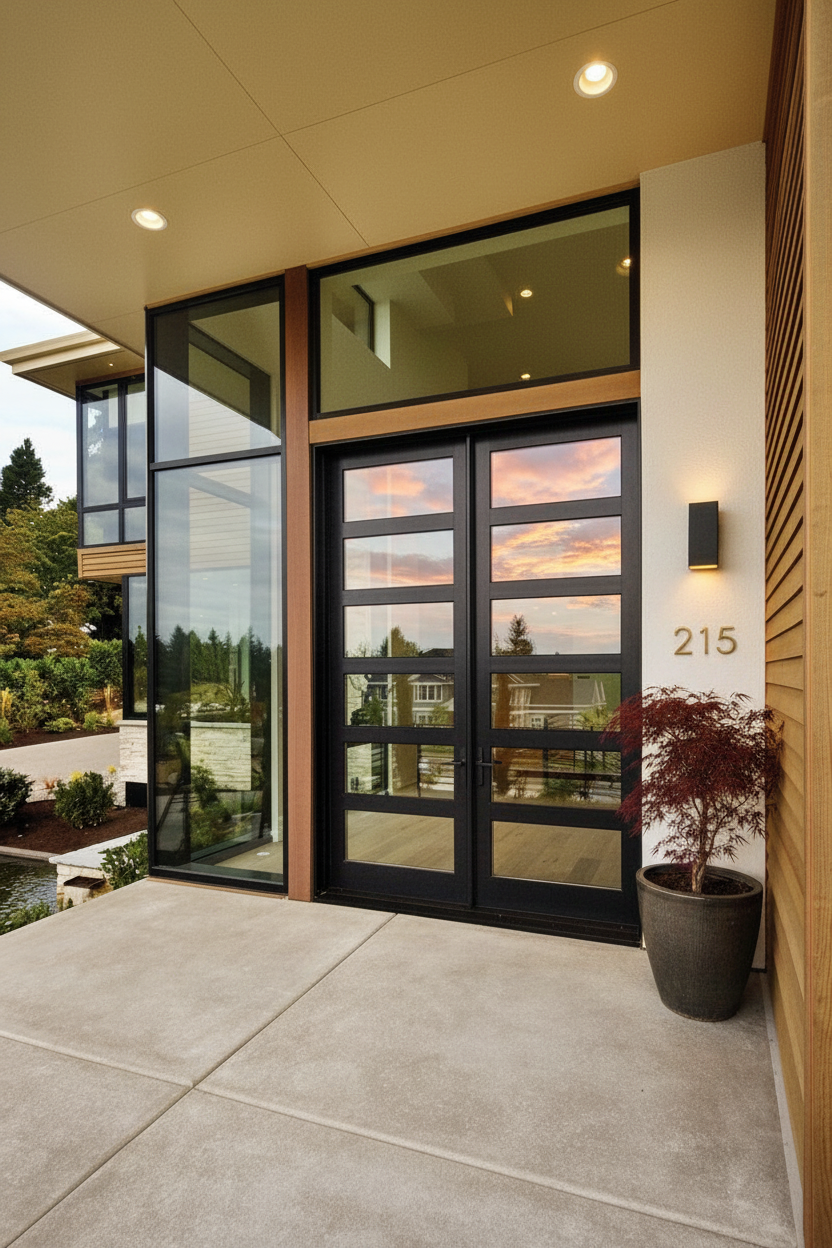
Door Installation
Door Installation in Temecula & Southern California
Installing a door in a new opening — interior or exterior — in Temecula means framing, flashing, finish, and permit work that most handymen skip. Hot, dry summers with afternoon highs regularly above 95 F, cool evenings, and occasional Santa Ana wind events in fall that push fine dust through unsealed sashes. We do it as a single-crew install so the rough opening, the jamb, and the casing all arrive plumb and square.
What homeowners come to us for — door installation
We see three categories on Temecula door installs: remodel-time exterior doors (new opening in a framed wall), interior barn-door retrofits on master suites, and patio wall cut-outs that enlarge an existing 6-ft slider into an 8-ft or 12-ft multi-slide. The barn-door projects are the simplest; the multi-slide cuts involve engineered headers and, in some cases, shear-wall re-nailing.
New door installation in Temecula almost always means a structural change. Owners call us because they want a second exterior door off a remodeled kitchen, a primary-suite barn door where an old pocket used to be, or a wider multi-slide to replace a tired 6-ft slider. Each of those is a different job. The kitchen door needs a framed rough opening, a structural header sized to the load above, sheathing, flashing, siding patch, and drywall patch — plus the actual door install. The barn door is the simplest: no framing, just a 200-lb track, header block, and trim. The multi-slide is the heaviest: engineered header, shear-wall re-nailing in some plans, flashing membrane behind the stucco, and a permit package with plan check.
Interior doors look easy and mostly are — a pre-hung swap into an existing opening runs $450-$900 installed. But I've measured a lot of Temecula homes where the "existing opening" isn't plumb, the header settled, and the new pre-hung won't sit right without shimming the jamb back to square. That's where handyman installs fail — the door closes fine in August, binds in January when the framing swells, and the homeowner calls us in February to fix it. We shim to plumb on every install, even interior, and we use solid-core doors (solid-core MDF interior) instead of hollow-core because hollow-core telegraphs every impact for the next 20 years.
Barn-door installs are a sub-specialty I like doing. The track has to carry the full weight of the slab (usually 80-120 lb for solid-core), the header block behind the drywall has to actually hit studs (not just drywall anchors), and the spacer geometry has to let the door clear the baseboard and trim. Done wrong, the door rubs, the track sags, and the roller hardware fails in two years. Done right, Johnson Hardware or Rockler tracks last 20+ years. I prefer Johnson for commercial-grade residential work — the bearings and roller assemblies outlast Rockler's mid-tier stock by a measurable margin.
Products and brands we install in Temecula
Products used on Temecula door installs: exterior goes fiberglass pre-hung (every major manufacturer, premium or budget-premium tier); interior goes solid-core pre-hung (solid-core MDF, or paint-grade flush); barn-door systems run on Johnson Hardware or Rockler tracks. Hardware tier follows the customer's existing door set — we match knob, lever, and hinge finish so the new install doesn't read as a patch.
For new exterior installs in Temecula the product stack looks like replacement work — premium wood-grain fiberglass and budget-premium fiberglass pre-hungs, factory finished, hung into a framed rough opening we've sized to the exact unit dimensions. Rough opening tolerance is 1/2" nominal each direction; we shim to 1/8" at the jamb. For the flashing we use either Grace Vycor or DuPont FlexWrap tape at the sill pan, run the building paper over the top flange, and caulk the head flashing with OSI Quad or Big Stretch. That envelope detail is the difference between a 30-year install and a 10-year install — water that gets behind the siding has to have a path out, and the sill pan drains it out before it hits the subfloor.
For interior installs we use solid-core MDF interior or Jeld-Wen Architectural pre-hungs. Both are solid-core MDF or composite, both accept stain and paint, both arrive factory-primed. Hardware matters more than homeowners expect — Schlage F-series is the minimum I spec (commercial-grade pin tumbler, five-pin cylinder); Emtek runs mid-premium with better-looking lever profiles and a proper adjustable backset. Hinges: three 4-inch ball-bearing hinges per door (not the stamped-steel 3.5-inch builder standard). The hinge upgrade is $40-$80 per door and it's the single biggest factor in whether the door still swings true at year 20.
For barn-door systems I run Johnson Hardware 111SD for residential and 200PD for commercial-grade residential (same hardware, heavier bearings). 111SD is rated to 200 lb per slab, 200PD to 400 lb. Track length is unit width × 2 (so a 36" door needs a 72" track to clear the opening). Header block behind the drywall has to hit studs — we re-frame the header if it doesn't. Floor guide at the bottom is the forgotten detail: without it the door swings toward the wall on every open/close, the trim takes the impact, and the system fails at year two. We include a floor guide on every install.
We install in Temecula, Murrieta, Menifee, Wildomar, Lake Elsinore, Hemet, and 4 more nearby cities. See the full list on our service areas page or jump straight to door installation in Murrieta.
What Temecula Climate Zone 10 does to poorly-specified door installation
New door installations in Temecula climate have to account for thermal cycling from day one. A door unit that arrives in January at 55 F and gets installed in August at 105 F has already moved 1/4" in the frame before install day; that movement has to be absorbed in shim geometry and foam insulation, not in the finished jamb. A handyman who just nails the pre-hung frame to the rough studs creates a door that binds in winter and gaps in summer. We install with 1/8" shim tolerance at every jamb point, low-expansion foam (not batt insulation) at the perimeter, and Grace Vycor flashing at the sill. Interior doors in Temecula face a different failure mode: humidity swing. Winter rain hits 50-65% RH inside an unconditioned garage; summer hits 15-25%. Solid-core interior doors handle that swing without warping; hollow-core doors can telegraph it with visible creaks and sticky latches. We only install solid-core on interior doors for that reason. Barn-door tracks in Temecula face dust load on the bearings — we use Johnson Hardware bearings with sealed races because the open-race Rockler bearings pick up grit and seize within 3-5 years on west-facing runs.
Our door installation process
How a Temecula door install goes: we lock the rough-opening dimensions on the measure visit, order pre-hungs that fit exactly (shims exist for the 1/8" tolerances, not the 1" mistakes), then install in one visit — jamb, hardware, insulation, flash, caulk, casing. New exterior openings add framing and header work to the day's scope.
Single-opening interior installs are same-day. We arrive at 8 a.m., pull the existing door and casing, level the jamb, shim the pre-hung unit, nail the jamb to the king studs, insulate the perimeter, install the casing, install hardware, punch-clean, and walk the customer through operation by 4 p.m. That's one tradesman, one truck, full job.
Barn-door installs run 4-6 hours per opening. Lay out the track height (usually 84-90 inches AFF), confirm the header block hits studs behind the drywall, mount the track, hang the slab, install the floor guide, install the door pull and soft-close kit, cover fastener heads with trim rings, punch-clean.
New exterior openings run two to three days. Day one: frame the opening, set the header, sheath, wrap, flash the sill pan. Day two: install the pre-hung unit, plumb and level, insulate, flash the head, caulk. Day three (if needed): exterior trim, stucco or siding patch, interior casing, paint touch-up. Multi-slide wall cut-outs add engineered header work and plan-check time, so those run closer to a week start-to-finish.
Install sequencing and what a door installation day on your home looks like
Install day for new door work in Temecula depends on whether it's a simple swap, a barn door, or a new exterior opening. Simple swap: arrive 8 a.m., pull existing unit, set and shim new pre-hung, install hardware, done by 2-4 p.m. Barn door: arrive 9 a.m., locate studs behind drywall, mount track header block if needed, set track level, hang slab, install floor guide and soft-close, done by 3-4 p.m. New exterior opening (day one of typically two days): cut the opening in existing sheathing, frame the rough opening with king studs and jack studs, set the engineered header, sheath, install the weather-resistive barrier, flash the sill pan with Grace Vycor. Day two: set the pre-hung unit, shim, fasten, insulate, flash head, caulk, install interior casing, install hardware. For multi-slide wall cut-outs, day one is framing and shear-wall prep, day two is header setting and pre-hung install, day three is exterior trim and siding or stucco patch, day four is interior finish. Inspection hits at framing (before insulation) and at final (after hardware and trim).
Permits, Title 24 & HOA considerations
Permit trigger for Temecula door installs: any new rough opening or header change needs engineering + permit. Existing interior openings and like-for-like exterior swaps don't. Riverside County + City of Temecula follow the 2022 California Residential Code (CRC) and Title 24 Part 6 — U-factor ceiling for new windows is 0.30 in Climate Zone 10. Most master-planned communities (Redhawk, Paloma del Sol, Harveston) run HOA architectural review — we submit the product spec sheet and exterior color chip with your application. We handle the permit work inside the quote — no owner-pulled permits.
What door installation costs in Temecula
Installed pricing for Temecula door projects: interior pre-hung $450-$900 per opening; interior barn-door with track $1,200-$2,400; exterior single-door new opening $3,500-$6,500; exterior multi-slide cutout $15,000-$40,000+ with engineered header. Haul-away, flashing, and casing included in every line.
Price bands for Temecula installs: interior pre-hung $450-$900 per opening; barn-door system $1,200-$2,400 per panel; exterior new-opening with framing $3,500-$6,500 for a standard 36-inch door; 6-ft slider in a new opening $6,500-$11,000 (the new opening adds $2,500-$4,500 in framing, sheathing, flashing, and patch work over a straight replacement); multi-slide wall cut-out with engineered header $15,000-$40,000+ depending on opening width, engineering complexity, and siding restoration.
The single biggest cost driver is the permit path. Same-size swaps skip permit fees and plan-check time. New openings trigger permit + structural engineering + inspection — that adds $800-$2,500 to the project before the first hammer swing. I always quote the permit as a line item so the homeowner sees it; never buried in "install labor."
Written quote, written warranty. Every install line shows product cost, labor cost, permit cost, and any trim or finish work. No hidden "shop supplies" or "drive time" fees. The 2-year workmanship warranty (plus the manufacturer's limited lifetime on glass and frame) is in writing at contract signing.
How Drew writes a door installation quote — what's inside the scope of work
When I write a Temecula quote, it's a six-page document, not a napkin number. Scope lists whether the opening exists or needs to be framed, whether the permit is required, what the engineered header will be if structural, and any stucco, siding, or drywall patch work included. Pricing breaks out framing, permit + engineering, door unit, hardware, flashing, insulation, interior trim, exterior trim, and haul-away. For multi-slide jobs the structural engineering is a separate line item with the engineer's name and stamp identified. Schedule runs from measure to inspection to install to final. Payment schedule is stage-based: 10% signing, 30% at framing start, 30% at rough-in complete, 30% at final inspection. The written warranty is 10 years on workmanship plus manufacturer product warranties.
Why homeowners choose Temecula Windows & Doors
Drew Guthrie owns and runs Temecula Windows & Doors. When you call, you talk to the owner. When the crew shows up, it's our crew — not a subcontractor swapped in the day before. We carry full Riverside County and San Diego County licensing, pull our own permits, and write a 2-year workmanship warranty on every install — plus the manufacturer's limited lifetime warranty on the glass and frame.
Ready to get a real quote for door installation? Call (951) 757-4340 or request one online.
Door Installation by city
Door Installation — FAQs
How much does door installation cost in Temecula?
What is the difference between pre-hung and slab door installation?
Do you install barn doors and sliding track doors?
How long does a single exterior door installation take?
Can you install a door in a new rough opening?
Do I need a permit for a new door installation?
Keep Exploring
Other services we install
Top Service Cities
Where we install the most
Background Reading
Owner-written field notes
Pricing, product selection, permit rules, and why certain installs fail in Temecula's desert climate.
Visit the BlogStart your door installation project
In-home measure, written quote, and no pressure. We book a window, you book the rest of your day.