What Questions Should I Ask a Window Contractor in Temecula Before Hiring?
What questions should I ask a window contractor in Temecula before hiring? License, written specs, Title 24, warranty — 10 answers from CSLB #887882.
 Written by Drew Guthrie, Owner & Lead Estimator · Updated June 30, 2026
TL;DR
- What questions should I ask a window contractor in Temecula before hiring?
- License, written specs, Title 24, warranty — 10 answers from CSLB #887882.
Before you hire a window contractor in Temecula, ask five things: the CSLB license number and classification, who pulls the permit, what's on the written spec sheet (frame, glass package, U-factor, SHGC), how the job meets Title 24, and what the workmanship warranty covers in writing. A contractor who won't answer these directly isn't worth your time.
- Verify the CSLB license number before the conversation goes any further
- Your contractor should pull all permits and be present for the inspection
- Every quote must list the frame system, glass package, U-factor, SHGC, and hardware by name
- Title 24 compliance isn't optional in California — it's the law
- Get both the workmanship warranty and the manufacturer warranty in writing before work starts
This article gives you specific questions — and the specific answers you should hear. Not vague "what's your experience" softballs. Technical questions that separate a contractor who knows the job from one who's hoping you don't know the difference.
Why Does Licensing Matter More in California Than Anywhere Else?
The California Contractors State License Board (CSLB) licenses contractors by classification. Window and glass installation is the C-17 (Glazing) classification. A B (General Building) contractor can take a prime contract that involves at least two unrelated trades besides framing and carpentry; for a windows-only job, a B contractor needs the C-17 classification or has to subcontract the work to a C-17 contractor.
Hiring unlicensed or uninsured help carries real risk. CSLB warns that if workers on your project aren't licensed or don't carry liability or workers' compensation insurance and they're injured, you could be asked to pay for their injuries through your homeowner's insurance policy or face a lawsuit.
The question to ask: "What's your CSLB license number — and can I look it up right now?"
A licensed contractor answers immediately, often with the number printed on a card. Verify it at cslb.ca.gov. You'll see whether the license is active, its classification, any disciplinary actions, and whether the bond and workers' comp are current.
Will You Pull the Permits — Or Am I on My Own?
Permit-pulling is where corners get cut, quietly.
Some contractors position the permit as your problem. They'll say something like "you'll need to pull the permits at the city" or "we can handle that for an extra fee." That's a red flag. A licensed general contractor should handle all required permits for the scope of work.
Temecula is its own city, so permits inside city limits go through the City of Temecula Building & Safety Division; unincorporated areas go through Riverside County. Replacement windows fall under California's Energy Code alteration rules, and changing an opening is structural work. Your contractor should confirm permit scope with the right department before the quote is final.
That permit trail matters. It shows the work was inspected and puts a licensed contractor of record on file.
The question to ask: "Will you pull every required permit, be on-site for the inspection, and include that cost in the written quote?"
The answer should be yes — yes to pulling, yes to showing up, yes to writing it down. If the contractor hesitates or tells you permits "probably aren't needed" for your job, walk.
What Exactly Is on the Quote? (And Why "A Window" Isn't an Answer)
This is where most homeowners get burned.
A contractor gives you a price to "replace six windows." You sign. Work starts. You end up with a frame system you didn't choose, glass that barely meets California's energy code, and hardware that costs extra to swap out because nothing was specified in writing.
A real quote is a spec sheet.
- Frame system — vinyl, fiberglass, aluminum-clad, or composite, and the specific product line by name
- Glass package — dual-pane or triple-pane, low-e coating type, gas fill (argon is standard), and the actual U-factor and SHGC values
- Lockset and hardware — by model number, not "standard hardware"
- Flashing detail — how water is managed at the head, jambs, and sill
- Permit fee — included or itemized separately
- Haul-away — old frames and sash, included or billed extra
California's Energy Code requires manufactured windows to carry a label listing U-factor and Solar Heat Gain Coefficient (SHGC), rated through the National Fenestration Rating Council (NFRC) or taken from the code's default tables. Those numbers decide whether a window meets Title 24. A contractor who can't tell you those values before installation doesn't know what they're ordering, or doesn't want you to know.
The question to ask: "Can you give me a written spec sheet before I sign — with the exact frame, glass package, U-factor, SHGC, hardware model, and what's included for cleanup and haul-away?"
If window replacement is on your list, that level of specificity is the baseline you should hold any contractor to. Every quote from Temecula Windows & Doors itemizes all of the above in writing — before you sign anything.
Are You Title 24 Compliant — and Who Handles That Paperwork?
Title 24, Part 6 is California's Building Energy Efficiency Standards. The current 2025 edition applies to permit applications submitted on or after January 1, 2026. It sets maximum U-factor and maximum SHGC values for replacement windows and glazed doors by climate zone.
Temecula is in Climate Zone 10, where replacement windows need a U-factor of 0.30 or lower and an SHGC of 0.23 or lower, or U-0.40 and SHGC 0.35 for jobs replacing 75 square feet of glass or less. The limits differ by climate zone, so ask for the Zone 10 numbers specifically.
According to the U.S. Department of Energy, heat gain and heat loss through windows are responsible for about 25–30% of residential heating and cooling energy use. Title 24 sets a minimum standard for that. If installed windows don't meet it and the inspection fails, they may have to come out and be replaced with compliant units.
The question to ask: "Do you pull the Title 24 compliance documentation yourself, and will you be on-site when the inspector comes?"
The answer should be yes on both. A contractor who understands Title 24 knows your climate zone, knows which glass packages pass, and doesn't leave you dealing with an inspection failure alone.
Door replacement can carry the same requirements. Under Title 24, an exterior door with 25 percent or more glass is a glazed door and must meet fenestration limits, which covers most sliding and multi-track doors. Know who handles that paperwork before work begins.
What's the Warranty — Workmanship vs. Manufacturer?
These are two different things. Most contractors blend them together in conversation. Don't let them.
Manufacturer's warranty covers the glass unit, frame, and hardware against product defects. Terms vary by manufacturer and series. Milgard, for example, publishes a Lifetime Limited Warranty with territory restrictions. Ask for the actual warranty document, not a verbal summary in your driveway.
Workmanship warranty covers the installation. The flashing, the frame fit, the water seal, the sash operation. If your window leaks in year two, is that a manufacturing defect or an installation defect? The answer determines which warranty applies. And if the contractor has no workmanship warranty, you have no recourse when it turns out to be their mistake.
The question to ask: "What is your workmanship warranty, in writing, and is it separate from the manufacturer's warranty?"
Temecula Windows & Doors gives a 2-year workmanship warranty in writing, and the manufacturer adds its limited lifetime warranty on the glass. Both are documented before the job starts.
How Long Will the Job Take — and Who Actually Does the Installation?
Both parts of this question matter.
On timeline: a same-size window swap with no structural changes is typically a one-day job, and full-home projects typically take two to three days. Multi-slide systems, bi-fold walls, and projects that need new-construction frames take longer and should be scheduled accordingly.
If a contractor says they'll "knock out" a full-home replacement in a few hours, ask how. That timeline usually means they're cutting corners on prep, caulking, or cleanup — or more crew is showing up than they've disclosed.
On who does the work: Most homeowners never think to ask this. Does the company you're signing with actually install the job? Or do they hand it to a subcontractor network, and whoever's available that week shows up on your property?
There's nothing inherently wrong with subcontracting. But you should know who's coming, whether they're licensed, and whether the contractor who signed your agreement is personally accountable for the work they perform.
The question to ask: "Who does the actual installation — your own crew or subcontractors? Are they licensed? And will you personally be on-site?"
Have You Installed Windows or Doors in My Specific Situation Before?
Not every home is the same job.
Temecula has 1990s and 2000s tracts such as Redhawk, Paloma del Sol, and Harveston, plus older custom homes in the Wine Country area. Each has different wall construction, frame cavities, stucco conditions, and header situations.
A vinyl retrofit frame in a 1996 stucco track home is a different job than a new-construction aluminum-clad window in a wood-framed custom build. The installation details — flashing approach, backing material, sill drainage path — are not the same. An experienced installer knows the difference before they pick up a pry bar.
Ask about your specific scenario:
- "Have you installed retrofit frames in stucco homes like mine?"
- "Do you have experience with multi-track or pocket door systems?"
- "Have you handled door installation for large sliding glass walls in residential projects?"
A contractor who's done the work answers precisely. One who hasn't talks around it.
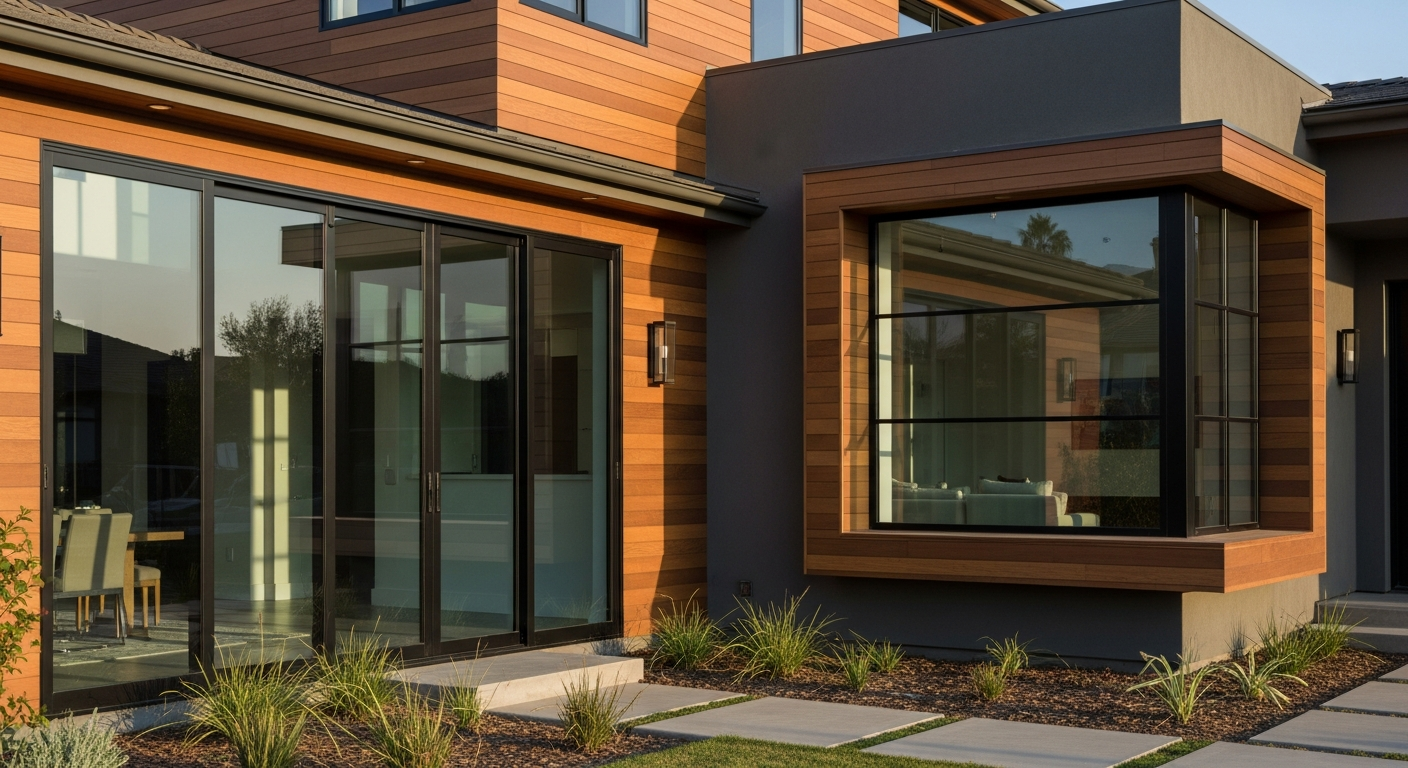
Sliding glass wall systems are a specialty at Temecula Windows & Doors — multi-track, bi-fold, and pocket configurations. These jobs involve different thresholds, different pocket framing, and different drainage requirements than a standard hinged door. If that's what you're planning, ask specifically about it.
What Brands and Frame Systems Do You Actually Install?
This matters more than most homeowners realize.
Not all vinyl is the same, and not all fiberglass performs the same. The brand and product line on your written quote tell you what you are actually getting.
The question to ask: "What specific window line do you install — manufacturer, product series, and frame material? Can I see a product spec sheet before we talk price?"
If the answer is "we install whatever the client wants" without a specific recommendation backed by documented specs, you're signing a blank check on material quality.
What Happens If Something Gets Damaged During Installation?
Accidents happen. A frame cracks during delivery. Stucco chips when the old frame comes out. Interior trim gets scratched. What the contractor says next tells you everything about how they operate.
The question to ask: "If something gets damaged during installation — my stucco, my drywall, my interior trim — how do you handle it? Is that written into the contract?"
The answer should be yes — it's in the contract, and damage caused during installation is the contractor's responsibility to repair or replace. If they balk at putting that in writing, ask yourself why they won't.
This isn't a hostile question. It's a standard protection. A contractor who's confident in their crew signs off on it without hesitation.
What Does a Good Final Walkthrough Look Like?
The job isn't done when the last window goes in. It's done when you've walked through the completed work and signed off on it yourself.
A thorough walkthrough covers:
- Operating every window and door installed — sash movement, latch engagement, lock function, hardware feel
- Checking all exterior flashing points and stucco repairs visually
- Confirming all old frames, sash, packaging, and debris are hauled away
- Reviewing the permit sign-off if an inspection was required
- Receiving all warranty documents in writing before the crew leaves
The question to ask: "What does your final walkthrough include, and when do I receive the warranty documents?"
A contractor who rushes you to sign a completion form before you've walked the project doesn't want you to find what they didn't finish. Take your time. The warranty clock starts when you sign.
How Do Sundeck and Outdoor Projects Change the Permit Equation?
If your project includes an outdoor structure — sundeck construction that ties into a new door opening, for instance — the permit requirements get more complicated. You may need a structural permit and a building envelope permit. Both trades have to coordinate.
Ask specifically:
- "If the sundeck ties into the door opening, who coordinates the permits between the trades?"
- "Does your license cover both the carpentry and the glazing work?"
- "Will the inspector sign off on both elements in one visit, or do we need two separate inspections?"
These aren't questions most homeowners think to ask. A contractor who answers them clearly has done this before. One who hasn't gives vague answers and hopes the coordination works itself out on your dime.
What Red Flags Should Make Me Walk Away From a Window Contractor?
You don't need a polished checklist if a contractor does any of these:
- Won't give a CSLB number up front. There's no legitimate reason to hesitate.
- Vague on the spec sheet. "A window" is not a specification. If there's no frame system, glass package, or U-factor on the quote, you don't have a quote — you have a number without a product.
- Cash-only with no written contract. A licensed contractor provides a written contract. No exceptions.
- Won't be on-site for the inspection. That tells you they're not pulling permits themselves — or they're not the one accountable when the inspector shows up.
- Pressure to sign today. A contractor who applies urgency before you've reviewed the spec sheet doesn't want you to review the spec sheet.
- No workmanship warranty. The manufacturer warranty doesn't cover installation. If there's no separate workmanship warranty in writing, you have no protection when the leak turns out to be their fault.
Test Your Knowledge
1. What risk does the article warn about when hiring an unlicensed window contractor?
- A. The project timeline will be significantly delayed
- ✅ B. You could be asked to pay for an uninsured worker's injuries through your homeowner's insurance or face a lawsuit
- C. You'll automatically be fined by local authorities
- D. The manufacturer won't honor any product warranties
CSLB warns that if unlicensed or uninsured workers are injured on your property, you could be asked to pay through your homeowner's insurance policy or face a lawsuit.
2. Which license classifications typically cover window installation work in California?
- A. Class A (Plumbing) and Class D (HVAC)
- ✅ B. Class B (General Building) and Class C-17 (Glazing)
- C. Class E (Electrical) and Class F (Roofing)
- D. Class G (Concrete) and Class H (Masonry)
Window and glass installation is the C-17 (Glazing) classification. A B (General Building) contractor can include windows in a multi-trade project; for a windows-only job it needs the C-17 classification or a C-17 subcontractor.
3. Name three technical specifications that should appear in a contractor's written window quote.
The frame system (vinyl, fiberglass, aluminum-clad, or composite), glass package (dual-pane or triple-pane), and hardware specifications. The article also mentions U-factor and SHGC values should be included by name.
4. What does the article say a homeowner should do before agreeing to work with a licensed contractor?
Verify the CSLB license number at cslb.ca.gov to confirm the license is active, check the license type, review any disciplinary actions, and confirm the bond and workers' compensation certificate are current.
Ready for a written quote?
Call (951) 757-4340 or request a free quote online. Drew will be at your door within a week.