Windshield Replacement Temecula CA: Why Your Home Windows Are Often the Real Issue
Windshield replacement Temecula CA searches often mask a home window problem. Learn Drew's warning signs, Title 24 rules, and what a real assessment covers
 Written by Drew Guthrie, Owner & Lead Estimator · Updated July 21, 2026
TL;DR
- Looking for windshield replacement in Temecula, CA? Temecula Windows & Doors doesn't do auto glass. We replace home windows and doors; for a car windshield, call an auto glass shop or your auto insurer.
- Home window replacement is construction work on your wall: rough opening assessment, frame system selection, California Title 24 energy compliance documentation, and, where a permit is required, an inspection by the City of Temecula or Riverside County.
- The clearest signals your windows need replacing: condensation locked between panes, drafts through a closed and latched window, soft spots or rot in the frame, or a sustained unexplained rise in utility costs.
- Under California's 2025 Energy Code, replacement windows in Climate Zone 10 (Temecula) need a maximum U-factor of 0.30 and a maximum Solar Heat Gain Coefficient of 0.23, with a U-0.40 and SHGC 0.35 allowance for jobs replacing 75 square feet of glass or less.
- If the glass problem is at your house, read on.
- Looking for windshield replacement in Temecula, CA? Temecula Windows & Doors doesn't do auto glass. We replace home windows and doors; for a car windshield, call an auto glass shop or your auto insurer.
- Home window replacement is construction work on your wall: rough opening assessment, frame system selection, California Title 24 energy compliance documentation, and, where a permit is required, an inspection by the City of Temecula or Riverside County.
- The clearest signals your windows need replacing: condensation locked between panes, drafts through a closed and latched window, soft spots or rot in the frame, or a sustained unexplained rise in utility costs.
- Under California's 2025 Energy Code, replacement windows in Climate Zone 10 (Temecula) need a maximum U-factor of 0.30 and a maximum Solar Heat Gain Coefficient of 0.23, with a U-0.40 and SHGC 0.35 allowance for jobs replacing 75 square feet of glass or less.
- If the glass problem is at your house, read on.
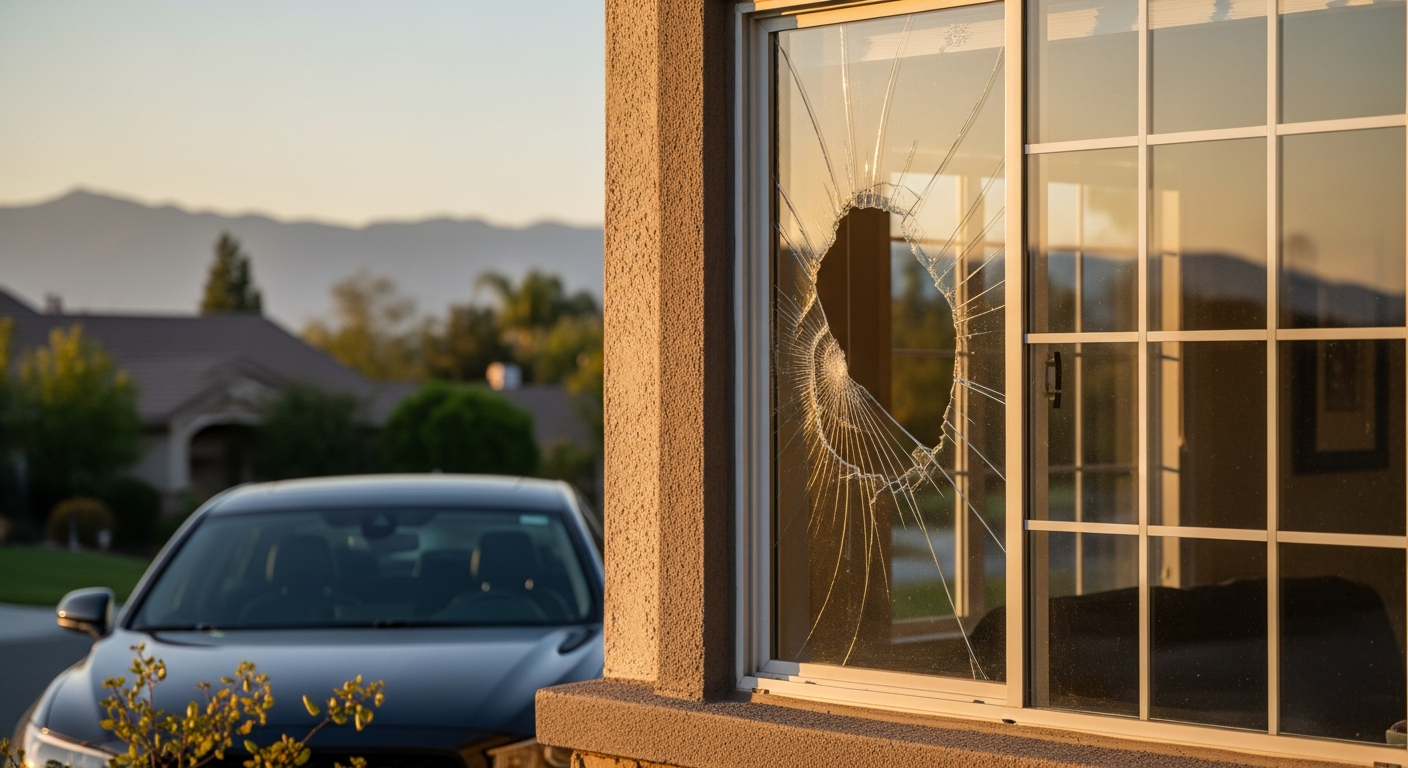
Why Does a "Windshield Replacement" Search Lead to a Home Window Company?
Some people searching for "windshield replacement" are really dealing with a house window: fog between two panes, a draft they can't trace, or a cracked pane. If that's you, this article covers what to check.
If the problem is a vehicle windshield, this isn't your stop. We don't do auto glass; a local auto glass shop or your auto insurer can help.
Residential window replacement is a different trade. The glass unit sits in a frame that has to seal to a rough opening in your wall, with structural framing, moisture barriers, and flashing. That opening gets assessed before any product is ordered, and permitted work gets inspected by a building official.
This article is for homeowners whose problem is at the house, not in the driveway.
What Warning Signs Tell You Your Home Windows Need Replacement Rather Than Repair?
The clearest signal is condensation trapped between the panes.
Fog on the interior glass surface that clears once the sun hits it is room humidity condensing on cool glass. Normal. What doesn't clear is moisture inside the insulated glass unit itself. If you see a fogged or hazy patch between the two panes regardless of time of day, the seal has failed. That usually means replacing the glass unit; if the frame is sound, it doesn't necessarily mean replacing the whole window.
Air movement through a locked, closed window is the second major signal. Run your hand along the perimeter of a fully closed and latched window on a windy day. You shouldn't feel anything. If you do, you're dealing with weatherstripping failure, a degraded frame seal, a frame that's shifted out of square, or some combination of all three.
Other signals that push the call from repair to full replacement:
- Visible rot or soft spots in the frame material, especially at the corners or along the sill
- Warping that prevents the sash from operating smoothly or from seating flush when closed
- Water staining on the sill, on the wall below the window, or on the baseboard beneath it
- A sustained, unexplained rise in heating or cooling costs that can't be traced to your HVAC system
That last one gets dismissed longer than it should.
The Energy Loss Number That Changes the Calculation
The U.S. Department of Energy says heat gain and heat loss through windows are responsible for about 25–30% of residential heating and cooling energy use.
Source: U.S. Department of Energy, Energy Saver, "Update or Replace Windows"
What it means for you: in a cooling-dominated climate like Temecula's, old or failed windows on south- and west-facing walls add to your air-conditioning load all summer.
Older Temecula homes can still have original single-pane or early aluminum-frame windows. The Energy Code puts a default U-factor of 1.28 on an unrated single-pane metal operable window, against a Zone 10 limit of 0.30, so replacing those units with rated low-e dual-pane windows makes a large difference in heat flow.
Code compliance adds another layer. Under Section R310 of the 2022 California Residential Code, emergency escape openings in sleeping rooms need a net clear opening of at least 5.7 square feet (5.0 square feet for grade-floor openings), a clear height of at least 24 inches, and a clear width of at least 20 inches. A window that's warped or stuck shut can't serve as that escape opening.
How Is Home Window Replacement Different From Windshield Replacement?
Almost everything is different.
Auto glass is a separate trade. No building permit, energy code, or rough-opening assessment is involved.
Home window replacement starts with an assessment of the rough opening in your wall — the hole the window sits in, with its framing, sill plate, moisture management requirements, and dimensional condition. All of that gets evaluated before anything is ordered.
Here's what the assessment covers:
The rough opening. The hole in your wall has to be the right size for the replacement unit, and plumb, level, and square enough to seat the frame correctly. If a previous installer wasn't precise, you're working with gaps, shim problems, and code issues before a single screw goes in.
Sill plate and wall cavity condition. With the trim off, the installer can see whether the original window had a sill pan or back dam, or relied on exterior caulk alone.
If water has been getting behind the frame, correcting it during replacement means installing proper sill pan flashing before the new frame goes in. Skipping that step seals a new window over the same leak path.
Title 24 compliance documentation. California's energy code sets performance limits for replacement windows in each climate zone, and Temecula is in Climate Zone 10. The documentation is confirmed at the assessment visit and submitted with the permit application.
NFRC label verification. California's Energy Code requires manufactured windows to carry a label listing U-factor, Solar Heat Gain Coefficient, and visible transmittance, rated through the National Fenestration Rating Council (NFRC) or taken from the code's default tables. Those are the numbers checked against the Title 24 limits.
None of this applies to a car windshield, which is why we stick to home windows and doors.
What Does Temecula's Climate Actually Do to Window Systems Over Time?
This region is hard on window assemblies. Hot, sunny summers and cool nights mean frames, sealants, and glass seals expand and contract through a wide temperature range every year.
Strong sun also ages exterior caulk, especially on south- and west-facing walls.
What it means for you: check the exterior caulk at south- and west-facing windows as part of routine maintenance, and confirm it is intact before you rule out a window as the source of a leak.
Thermal cycling stresses insulated glass seals over time.
Every day, the glass unit and the spacer system inside it expand and contract with temperature. Over years of that cycling, seals fatigue. When they fail, condensation appears between the panes.
Weep holes clog in dusty, dry conditions.
The small openings at the bottom of the frame channel water that enters the sill track back to the exterior. Dust, debris, and spider webs can block them. When they clog, rain that enters the frame has nowhere to drain. It pools against the sill and eventually works into the framing.
Older custom homes and ranch properties often have non-standard rough openings. Retrofit replacement frames, sized to fit inside the existing opening with the original frame left in place, are often the right product for those sites. New-construction frames with nailing fins are built for a different installation condition.
What Energy Numbers Actually Matter for Temecula Windows?
Most homeowners arrive focused on U-factor. That's a reasonable starting point — but it's incomplete for this climate.
U-factor measures a window's resistance to heat transfer. Lower values mean better insulation. In cold-winter markets, U-factor is the dominant specification. In Temecula, where the seasonal goal for five to six months is keeping heat out, U-factor matters — but it doesn't tell the whole story.
Solar Heat Gain Coefficient (SHGC) is the fraction of the solar heat striking a window that ends up inside as heat. In a sunny, cooling-dominated climate, a lower SHGC directly cuts the solar load on your air conditioner.
California Title 24 — Climate Zone 10 Window Requirements
Source: California Energy Commission, 2025 Building Energy Efficiency Standards (Title 24, Part 6), Table 150.1-A and Section 150.2(b)1B. The 2025 code applies to permit applications submitted on or after January 1, 2026; Climate Zone 10's window limits are unchanged from the 2022 code.
Under the prescriptive compliance path for Climate Zone 10, replacement windows must meet these area-weighted maximums:
- Maximum U-factor: 0.30
- Maximum Solar Heat Gain Coefficient: 0.23
What it means for you: a window with a U-factor of 0.28 and an SHGC of 0.27 looks solid on paper. It doesn't pass. Both values have to clear the limit, not just one. (Jobs replacing 75 square feet of glass or less may use U-0.40 and SHGC 0.35 instead.) Any quote that doesn't show the NFRC-rated values against these limits isn't a complete specification.
Projects that combine window work with sundeck construction or a covered addition should be planned together. A new roof over a window wall changes how much sun that glass gets, and the window and deck scopes need to line up in the permit paperwork.
Orientation still matters. West-facing windows take direct afternoon sun, so a low SHGC there does the most work. Title 24's SHGC limit applies to every orientation, but you can choose a lower SHGC than the minimum on west and south walls. Ask how a contractor handles orientation when specifying across the whole house.
Frame material is a performance decision, not only an aesthetic one. Vinyl handles most residential window openings; fiberglass takes a painted finish and holds its shape; aluminum frames are common on wide door installation openings such as multi-slide doors.
When reviewing any written quote, ask for the NFRC label data on every unit being specified: U-factor and SHGC listed, confirmed against Title 24 thresholds, and explained in the context of your specific wall exposures.
What Misconceptions Do Temecula Homeowners Bring to a Window Replacement Consultation?
Several come up consistently, and they matter because they affect the quality of the specification homeowners end up accepting.
The glass is the whole product.
Homeowners call asking about triple-pane options or specific low-e coating configurations. Those are reasonable questions — but they start too far into the specification. The conversation has to back up to the frame first: how it seals to the rough opening, what material it's made from, and whether it's a new-construction frame or a retrofit replacement frame. These are genuinely different products for different site conditions.
A new-construction frame carries a nailing fin around its perimeter, designed to attach to the rough opening before exterior cladding goes on. A retrofit frame is sized to fit inside an existing opening with the original frame left in place. Using a new-construction frame in a retrofit condition creates fit, flashing, and eventually seal problems.
Standard sizes fit any opening.
Rough openings vary. Non-standard dimensions — common in older Temecula properties, wine country ranches, and additions built across multiple decades — mean the replacement unit has to be manufactured to fit. Homeowners expecting a fast turnaround don't always account for the production lead time on custom-dimensioned units.
Frame material is a cosmetic choice.
Frame color is cosmetic. Frame material is a performance specification. Each material carries real tradeoffs based on the application, the span, and what the opening demands structurally. That distinction matters most on wide openings for door replacement projects, where structural load requirements differ from a standard window opening. On a wide sliding or multi-slide opening, a frame material that works fine on a 36-inch casement may not carry the load correctly at ten or twelve feet.
The lowest bid is a price for the same product.
It rarely is. When a bid comes in far below the others, something was usually cut to hit that number: frame wall thickness, weatherstripping, spacer material in the glass package, or hardware grade. Those cuts show up over time as a sash that stops operating smoothly, a corner seal that fails, or hardware that wears out early.
One failed window means all the windows need replacing.
Not necessarily. One failed seal on a single unit may be addressable with a glass-unit replacement into the existing frame, if the frame itself is in good structural condition. The assessment determines the scope. Replacing sound frames unnecessarily adds cost without adding performance. The goal is to replace what actually needs replacing.

What Does an Actual Window Replacement Assessment Cover?
The product specification comes after the assessment — never before.
Trim comes off first. That exposes the rough opening — the condition that determines what product fits, how it needs to be flashed, and what's been happening inside the wall cavity before the new frame goes in.
Rough opening dimensions and squareness. Is the opening sized for a standard replacement unit, or does it require a custom order? Is it plumb and within square? Out-of-square openings require shimming that affects how the frame seats and operates long-term.
Sill plate condition. Rot at the sill plate changes the project scope entirely. New windows anchored into a compromised sill won't hold their position or maintain their seal. This gets confirmed before anything is ordered.
Wall cavity moisture. If water has been tracking behind the existing frame — through failed caulk, missing flashing, or blocked weep holes — the cavity needs to dry out and the moisture entry point needs to be corrected before the new unit goes in. Installing new windows into a wet wall cavity doesn't fix the problem. It delays the visible symptoms while damage continues behind the new frame.
Original flashing detail. Was there a back-pan flashing at the sill? A weep screed? Proper back-bedding of the frame against the rough opening? Missing flashing details get corrected during replacement. They can't stay behind the new frame.
Weep hole condition. Drainage paths get cleared before the new unit sets. Installing a window over clogged weep holes traps the next rainfall in the sill track against the new frame.
The same sequence applies to door replacement projects: rough opening first, framing condition, any moisture around the existing unit, then product specification. The failure modes are identical. The root-cause analysis is the same. The sequence doesn't change because the opening doesn't care whether a window or a door is going back in.
Title 24 documentation starts at the site visit. Addresses inside Temecula city limits permit through the City of Temecula Building & Safety Division; unincorporated areas go through Riverside County. A licensed contractor who knows both files with the right department. Replacement windows in sleeping rooms also need to keep the escape-opening sizes required by Section R310 of the California Residential Code.
Every project is quoted in writing after measure — spec sheet, glass package with U-factor and SHGC confirmed against Title 24 thresholds, hardware model, flashing specification, permit fee, and haul-away of old units, all itemized separately. Nothing bundled under a vague line item. To request a written assessment, visit temeculawindowanddoor.com/contact-us/#freequote or call (951) 757-4340.
Ready for a written quote?
Call (951) 757-4340 or request a free quote online. Drew will be at your door within a week.